Modern Mercantilism, Climate Risk & Sovereign Resilience: A Forward-Looking Strategy for Canada (Augmented with Chatgpt 5.1)
- Leke

- Dec 12, 2025
- 5 min read
By Leke Abaniwonda — Industry 5.0 Innovation Consultant & Founder, Wonda Design
Introduction — A Regime Shift in the Global Order
Recent research from Bridgewater Associates describes a structural transition in the global economic system, one in which the post-World War II liberal order of free trade and limited government intervention is being replaced by modern mercantilism — an era where states actively orchestrate economic policy to increase national wealth, strength, and self-sufficiency. Under this paradigm:
government plays a larger role in directing industrial policy,
trade balances and self-reliance are central to national strategy, and
strategic sectors are protected or nurtured to maintain competitive advantage.Bridgewater+1
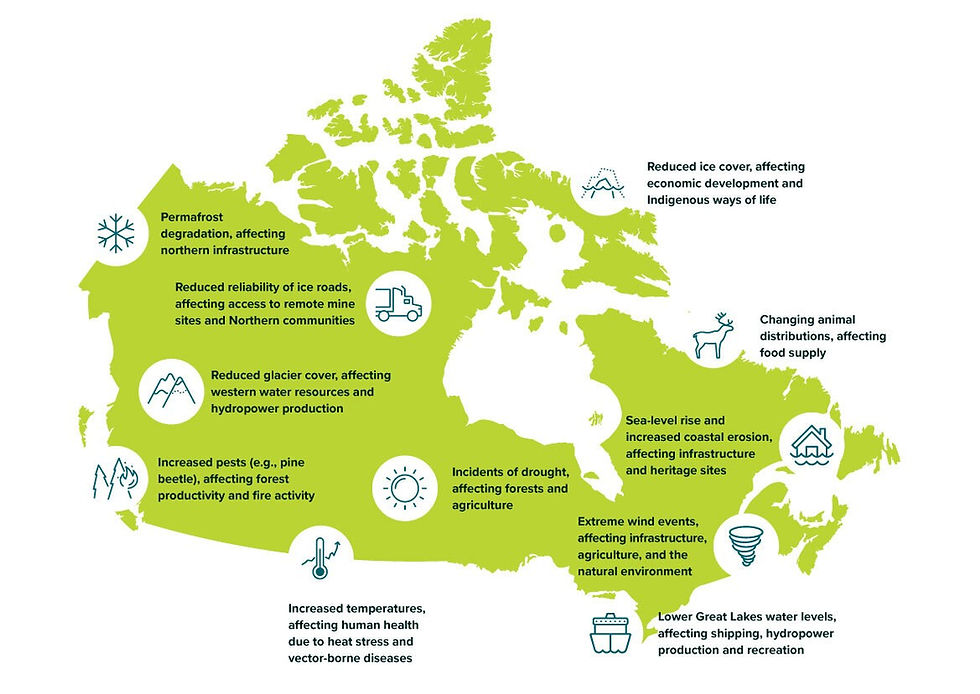
In this context, climate change — already imposing significant risk exposure on Canada’s housing, infrastructure, and financial systems — must be framed not as an isolated environmental problem, but as a sovereign strategic risk. If the nation is to be resilient, it must adopt policy frameworks capable of anticipating and mitigating systemic threats before they cascade.
To do this, we can draw on sequential backcasting and futurecasting — two methodologies that help governments and organizations plan robust strategies by starting with desired future outcomes and mapping backwards to the present, while continuously checking forward against risk trajectories. This article outlines how such a framework — informed by the realities of modern mercantilism — can guide Canada’s policy design across governance, infrastructure, and innovation.
Modern Mercantilism: Implications for Sovereign Strategy
Bridgewater’s analysis highlights four core tenets of modern mercantilism:
The state takes an active role in economic orchestration.
Trade balances and national self-sufficiency are prioritized.
Industrial policy is a tool for strategic advantage.
National corporate champions are protected.Bridgewater
These principles are already reflected in policies around energy independence, critical minerals supply chains, and domestic technology manufacturing in the U.S. and China, and they increasingly inform European policy debates.Bridgewater
Climate risk intersects with this paradigm in three profound ways:
Climate hazards are strategic economic risks. Repeated flooding and wildfire losses — projected in the billions annually — undermine national wealth and financial stability.
Infrastructure vulnerability diminishes sovereign competitiveness. Unprotected housing stock, energy grids, and supply chains become liabilities in a mercantilist world where self-sufficiency is prioritized.
Risk management itself emerges as a strategic industrial capability. Nations that can govern, model, and mitigate climate-related exposures stand to enhance their economic resilience relative to peers.
Taken together, these trends signal that climate strategy must be integrated with sovereign economic planning, and that Canada should explicitly design policies that are forward-looking, risk-informed, and resilient.
Sequential Backcasting: Defining Canada’s Desired Future State
To operationalize this integration, Canada can adopt sequential backcasting, a five-step approach:
Define aspirational future end statesCanada thrives as a climate-resilient economy, with minimal loss from extreme weather events, robust housing that accommodates future climate realities, and infrastructure that supports economic competitiveness.
Identify critical barriers and risksThese include outdated zoning practices that permit development in flood zones, weak climate-aligned building codes, financial exposure in mortgage and insurance markets, and gaps in data and governance capacity.
Map policy and governance pathwaysUsing backcasting from the desired future to the present, chart policies that align fiscal, regulatory, and industrial levers with resilience goals.
Align with global mercantilist dynamicsIntegrate sovereignty-oriented approaches (e.g., robust domestic data governance, sovereign infrastructure standards, and homegrown technology capability) so that resilience enhances national competitiveness.
Implement adaptive feedback loopsUse data systems to continually monitor progress, recalibrate policy actions, and ensure adaptability over time — a key tenet of futurecasting.
This process transforms abstract goals into actionable policy sequences that address both climate risk and global strategic competition.
Four Pillars of a Sovereign Resilience Strategy
To act on this framework, Canada should prioritize four interlocking policy pillars:
1. Human-Centric Governance
Governance must shift from reactive compliance to proactive stewardship. Canada already has tools in development — such as the AI and Data Governance Standardization Hub (AIDG Hub) — that can be extended to climate and resilience ecosystems, ensuring that:
Transparency, accountability, and inclusivity are central to policy design.
Indigenous knowledge and community-based data are integrated into planning models.
Ethical, privacy-preserving data systems underpin national risk assessment capabilities.
This results in governance structures that are trusted by citizens and aligned with economic priorities — essential in a mercantilist world where social license is strategic.
2. Sovereign Resilience Policy
Sovereignty in this context extends beyond borders to include digital, infrastructure, and economic autonomy:
Zoning Reform: Update zoning laws to restrict development in high-hazard zones based on forward-looking climate projections.
Resilience Standards: Mandate climate-resilient building codes for new and existing housing, reducing future liabilities.
Industrial Incentives: Use industrial policy — tax incentives, grants, subsidies — to spur domestic industries focused on resilience technologies (e.g., flood-resistant materials, decentralized water systems).
This approach aligns with the mercantilist emphasis on state orchestration while positioning Canada as a leader in resilient innovation.
3. Adaptive Infrastructure Planning
Canada must integrate climate risk into all levels of infrastructure planning:
Modular, Redundant Systems: Build infrastructure with modular designs (e.g., microgrids, decentralized water retention) that can isolate failures without systemic collapse.
Climate-Informed Finance: Embed climate risk assessments into public and private financing criteria, affecting credit ratings, lending standards, and capital allocation.
Cross-Sector Coordination: Ensure coordination between energy, transportation, housing, and communication sectors so that resilience investments reinforce one another.
This ensures infrastructure supports competitive economic activity while withstanding climatic and geopolitical shocks.
4. Data-Driven Risk Management
Canada should treat data as a strategic asset:
National Climate Data Commons: Expand open, high-resolution climate and hazard datasets accessible across jurisdictions.
Predictive Risk Analytics: Deploy AI-powered models to foresee hazard patterns, economic impacts, and infrastructure vulnerabilities.
Standardized Reporting: Harmonize risk reporting across sectors to inform national planning and private investment decisions.
This layer integrates with governance and infrastructure planning, enabling adaptive, evidence-based policy decisions.
Anticipating Pushbacks & Necessary Shifts
A strategy of this scope will encounter resistance and require careful implementation:
Political and Fiscal Pushbacks
Short-Term Costs vs Long-Term Benefits: Initial investments in resilience and data infrastructure may face political resistance due to budgetary concerns.
Provincial vs Federal Jurisdiction: Harmonizing policies across provinces requires collaborative federalism and incentives for provincial alignment.
Economic and Industry Challenges
Industry Adjustments: Industries may resist new standards that increase upfront compliance costs; well-structured transition incentives are necessary.
Global Trade Dynamics: In a mercantilist world, aligning resilience strategies with trade policy requires careful negotiation to avoid retaliatory measures.
Cultural and Institutional Shifts
Mindset Change: Policymakers must move from reactive crisis management to anticipatory governance — a substantial institutional shift.
Human-Centric Metrics: Traditional economic indicators (GDP) must be complemented with resilience, equity, and sustainability metrics.
Strategic Outcomes — What Success Looks Like
By 2035, a successful implementation of this framework can yield:
Reduced Economic Losses: Diminished annual climate damage exposure through resilient housing and infrastructure.
Enhanced Sovereign Competitiveness: A robust domestic innovation ecosystem that exports resilience technologies and governance models.
Social Stability: Communities that withstand climate shocks without displacement or recurring reconstruction.
Geopolitical Leverage: A Canadian economic model that is less dependent on external supply chains and more capable of navigating mercantilist pressures.
Conclusion — From Risk to Strategic Resilience
Modern mercantilism signals a deeper systemic shift in how states manage economic power. For Canada, this is both a challenge and an opportunity: climate risk must be integrated into sovereign strategy, not siloed as “environmental policy.”
Using sequential backcasting to align long-term outcomes with today’s actions, and futurecasting to hedge against systemic economic and climate uncertainties, Canada can move from vulnerability to strategic resilience. By prioritizing human-centric governance, sovereign resilience policy, adaptive infrastructure, and data-driven risk management, the country positions itself not just to withstand shocks — but to lead.
In a world of shifting balances and national self-interest, resilience becomes strategy — and Canada’s future depends on choosing it today.
Citations:• Bridgewater Associates, We’re All Mercantilists Now — global economic paradigm and mercantilist dynamics. Bridgewater• Bridgewater Associates, Power Politics: Energy Self-Sufficiency in a Modern Mercantilist World — national self-sufficiency and energy policy.


Comments