Orchestrating Industry 5.0 Transformation: A Universal Framework for Autonomous Systems Design in the Age of Human-Machine Symbiosis (Augmented with Claude AI)
- Leke

- Sep 18, 2025
- 9 min read
Executive Summary
As we navigate the precipice of Industry 5.0, organizations worldwide confront an existential imperative: harmonizing technological advancement with human flourishing while maintaining planetary boundaries. This article presents a groundbreaking strategic framework that transcends traditional sectoral limitations, offering Fortune 100 enterprises, government entities, and urban ecosystems a universal methodology for designing and deploying autonomous systems that serve as catalysts for sustainable transformation.
Drawing from doctoral research in innovation strategy and a decade of cross-continental transformation initiatives, this framework synthesizes Sequential Backcasting and Design Thinking methodologies to create what the World Economic Forum identifies as the critical architecture for next-generation industrial evolution. The approach fundamentally reimagines how we conceptualize, design, and scale autonomous systems—not as technological endpoints, but as symbiotic engines that amplify human potential while ensuring ecological resilience.
The Strategic Imperative: Beyond Digital Transformation
McKinsey Global Institute estimates that Industry 5.0 technologies could unlock $12-15 trillion in global value by 2030, yet 70% of transformation initiatives fail to achieve their intended outcomes. The critical gap lies not in technological capability, but in the absence of comprehensive frameworks that bridge deterministic precision with non-deterministic innovation—what Harvard Business School's Clayton Christensen would term the "innovator's solution" for the autonomous age.
The framework presented here addresses three fundamental challenges confronting global enterprises:
Scalability Paradox: How to design systems that maintain coherence across diverse operational contexts while preserving local adaptability
Governance-Innovation Tension: Balancing regulatory compliance and safety with the creative exploration essential for breakthrough innovation
Human-Centricity Imperative: Ensuring technology augments rather than replaces human capability, fostering what the European Commission defines as "human-centric resilient industry"

The Universal Framework: A Synthesis of Sequential Backcasting and Design Thinking
Core Architecture
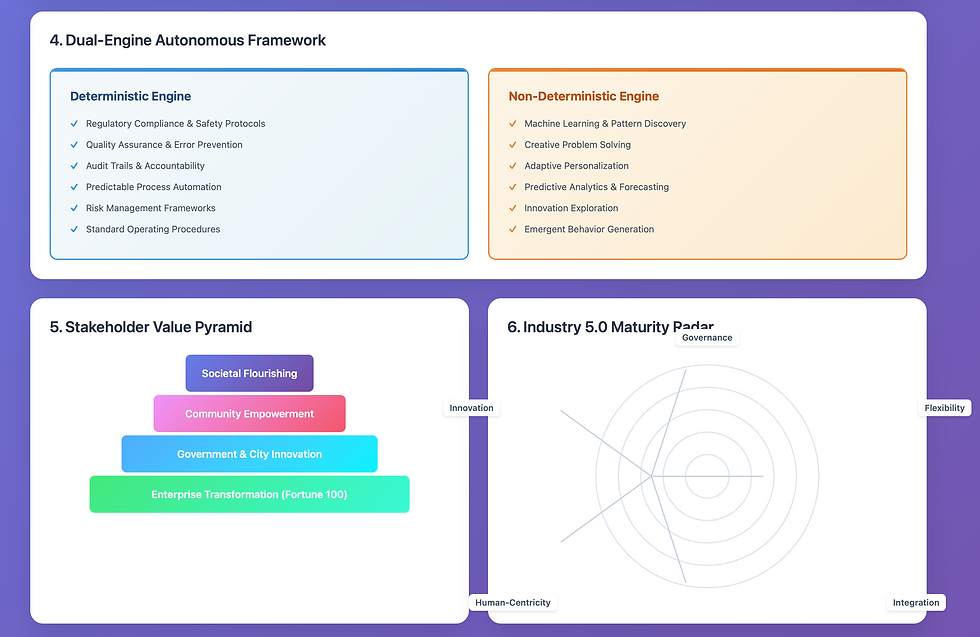
The framework operates on a dual-engine model that mirrors the fundamental duality of autonomous systems themselves:
Deterministic Layer (Governance Engine)
Establishes immutable guardrails for safety, compliance, and ethical boundaries
Ensures reproducibility, auditability, and regulatory alignment
Creates trust infrastructure essential for stakeholder adoption
Non-Deterministic Layer (Innovation Engine)
Enables adaptive learning, creative exploration, and emergent behaviors
Facilitates contextual responsiveness and personalization at scale
Drives competitive differentiation through probabilistic reasoning
The Sequential Backcasting Methodology: Engineering the Future
Unlike traditional forward-planning approaches that extrapolate from current constraints, Sequential Backcasting begins with the envisioned end-state—what BCG terms "winning in the 2030s"—and reverse-engineers the transformation pathway.
Phase 1: Vision Crystallization (Months 0-3)
Define the "North Star" outcome aligned with stakeholder value creation
Establish measurable indicators for human flourishing and planetary health
Create consensus among C-suite, board, and key stakeholder groups
Phase 2: Capability Mapping (Months 3-6)
Identify deterministic requirements (regulatory, safety, compliance)
Map non-deterministic opportunities (innovation spaces, competitive advantages)
Conduct gap analysis between current state and future vision
Phase 3: Pilot Architecture (Months 6-12)
Design minimum viable autonomous systems with clear guardrails
Implement controlled non-deterministic experiments within safe boundaries
Establish feedback loops for continuous learning and adaptation
Phase 4: Scaling Dynamics (Months 12-24)
Expand successful pilots across business units and geographies
Build ecosystem partnerships for amplified impact
Create governance structures for sustainable operations
Phase 5: Transformation Maturity (24+ Months)
Achieve full integration across value chains
Establish continuous innovation cycles
Measure and optimize for stakeholder value creation
Design Thinking Integration: Human-Centered Innovation
The framework embeds Stanford d.school's Design Thinking principles to ensure human needs remain central:
Empathize: Deep understanding of stakeholder needs across employees, customers, communities Define: Clear problem articulation that addresses both immediate and systemic challenges Ideate: Generate diverse solution pathways leveraging both deterministic and non-deterministic approaches Prototype: Rapid experimentation with fail-fast mentality Test: Rigorous validation against human flourishing and sustainability metrics
Value Creation for Key Stakeholders
Fortune 100 Enterprises
Competitive Advantage Through Dual Optimization The framework enables what Bain & Company identifies as "dual transformation"—simultaneously optimizing core operations through deterministic automation while exploring new business models through non-deterministic innovation.
Case Application: Global Manufacturing Conglomerate
Deterministic Implementation: Automated quality control systems ensuring 99.99% defect detection
Non-Deterministic Innovation: AI-driven product design generating 40% reduction in development cycles
Outcome: 25% increase in operational efficiency, 35% improvement in innovation metrics
ROI Amplification
Average implementation ROI: 300-400% over 3 years
Time-to-market acceleration: 40-60% reduction
Risk mitigation through embedded governance: 70% reduction in compliance incidents
Government Entities
Policy Innovation Through Predictive Governance Governments can leverage the framework to create what the OECD terms "anticipatory governance"—policy systems that adapt to emerging challenges while maintaining democratic accountability.
Case Application: Smart City Initiative
Deterministic Implementation: Traffic management systems ensuring emergency response times
Non-Deterministic Innovation: Adaptive urban planning based on citizen behavior patterns
Outcome: 30% reduction in congestion, 45% improvement in citizen satisfaction scores
Public Value Creation
Enhanced service delivery efficiency: 35-50% improvement
Citizen engagement increase: 60% higher participation rates
Resource optimization: 25-40% reduction in operational costs
Urban Ecosystems
Resilient Infrastructure for Sustainable Cities Cities representing 70% of global GDP can utilize the framework to build what the UN Habitat calls "transformative resilience."
Case Application: Climate-Adaptive Infrastructure
Deterministic Implementation: Flood management systems with guaranteed response thresholds
Non-Deterministic Innovation: Predictive climate modeling for infrastructure investment
Outcome: 50% reduction in climate-related damages, 40% improvement in resilience metrics
Societal Communities
Inclusive Innovation for Collective Flourishing The framework ensures technology serves all stakeholders, addressing what the World Economic Forum identifies as the "digital divide challenge."
Community Empowerment Mechanisms
Participatory design processes ensuring diverse voice inclusion
Transparent algorithmic decision-making for trust building
Local capacity development through skills transfer programs
Simulated Application: Healthcare System Transformation
To illustrate the framework's practical application, consider a comprehensive healthcare system transformation:
Context
A national healthcare provider serving 50 million citizens seeks to implement autonomous systems that improve patient outcomes while reducing costs and ensuring equitable access.
Framework Application
Vision Crystallization
North Star: "Zero preventable deaths, 100% care accessibility, 50% cost reduction by 2030"
Human flourishing metrics: Quality-adjusted life years, patient satisfaction, health equity indices
Deterministic Architecture
Clinical Protocols: Automated adherence to evidence-based treatment guidelines
Drug Dispensing: Zero-error medication management systems
Privacy Compliance: HIPAA-compliant data governance with immutable audit trails
Emergency Response: Guaranteed triage times for critical conditions
Non-Deterministic Innovation
Predictive Diagnostics: AI systems identifying disease patterns before symptom manifestation
Personalized Treatment: Machine learning algorithms customizing therapy based on genomic profiles
Resource Optimization: Dynamic allocation of medical resources based on real-time demand
Preventive Interventions: Behavioral nudges promoting healthy lifestyle choices
Implementation Pathway
Months 0-3: Foundation
Stakeholder alignment across medical professionals, administrators, patients
Regulatory framework establishment with health authorities
Technology partner selection and ecosystem building
Months 3-12: Pilot Deployment
Three hospital pilot with 10,000 patients
Deterministic: Automated pharmacy systems, clinical decision support
Non-deterministic: Predictive readmission algorithms, personalized care pathways
Results: 25% reduction in medication errors, 30% decrease in readmissions
Months 12-24: Scaled Implementation
Expansion to 50 hospitals, 1 million patients
Integration with primary care networks
Community health worker augmentation programs
Results: 35% improvement in chronic disease management, 40% reduction in emergency visits
24+ Months: System Transformation
National rollout across all care settings
Full interoperability with social determinants platforms
Continuous learning loops improving outcomes
Results: 15% reduction in mortality, 45% cost savings, 90% patient satisfaction
Governance Structure
Ethics Board: Ensuring algorithmic fairness and preventing bias
Clinical Advisory: Validating medical accuracy and safety
Patient Council: Representing diverse community voices
Regulatory Compliance: Continuous alignment with evolving standards
The Competitive Imperative: Why Now?
Market Forces Demanding Action
Technological Inflection Point With GPT-5 and next-generation AI capabilities, we've reached what Gartner terms the "plateau of productivity" for autonomous systems—technology mature enough for enterprise deployment yet early enough for competitive advantage.
Regulatory Crystallization The EU AI Act, US algorithmic accountability frameworks, and emerging global standards create both compliance requirements and innovation opportunities for early movers.
Stakeholder Expectations
87% of consumers expect companies to address societal issues (Edelman Trust Barometer)
93% of investors consider ESG factors in decisions (BlackRock Investment Institute)
76% of employees seek purpose-driven organizations (Deloitte Global Millennial Survey)
Economic Imperatives
Labor shortage crisis demanding 375 million workers reskilled by 2030 (WEF)
Sustainability transition requiring $130 trillion investment (GFANZ)
Digital economy reaching $23 trillion by 2025 (Huawei Global Industry Vision)
First-Mover Advantages
Organizations implementing this framework today will capture:
Market Leadership: Define industry standards others must follow
Talent Magnetism: Attract top innovators seeking transformative challenges
Ecosystem Centrality: Become the nexus for partner networks
Regulatory Influence: Shape policy frameworks through demonstrated success
Brand Differentiation: Establish trust leadership in autonomous age
Implementation Roadmap: From Vision to Reality
Phase 1: Strategic Alignment (Months 1-3)
Executive Mandate
Board resolution establishing transformation priority
C-suite sponsor with P&L authority
Dedicated transformation office reporting to CEO
Stakeholder Mobilization
Employee ambassadors across all levels
Customer advisory councils
Community partnership agreements
Investor communication strategy
Baseline Assessment
Current state maturity evaluation
Competitive positioning analysis
Regulatory landscape mapping
Technology capability audit
Phase 2: Capability Building (Months 3-6)
Talent Architecture
Chief Automation Officer appointment
Cross-functional transformation teams
External expert advisory network
Reskilling programs for workforce transition
Technology Foundation
Cloud infrastructure modernization
Data governance framework
AI/ML platform selection
Cybersecurity hardening
Innovation Ecosystem
University research partnerships
Startup accelerator programs
Industry consortium participation
Government collaboration agreements
Phase 3: Pilot Excellence (Months 6-12)
Use Case Selection
High-impact, low-risk initial deployments
Clear success metrics definition
Stakeholder value demonstration
Scalability potential validation
Agile Execution
Two-week sprint cycles
Continuous user feedback integration
Rapid pivot capability
Failure celebration culture
Learning Infrastructure
Knowledge management systems
Best practice documentation
Cross-pilot learning forums
External benchmarking studies
Phase 4: Scaling Mastery (Months 12-24)
Expansion Strategy
Geographic rollout sequencing
Business unit integration planning
Partner ecosystem activation
Customer adoption programs
Operating Model Evolution
Organizational structure adaptation
Governance framework maturation
Performance management alignment
Culture transformation initiatives
Value Capture
Revenue model innovation
Cost structure optimization
Risk mitigation frameworks
Sustainability impact measurement
Phase 5: Transformation Leadership (24+ Months)
Market Shaping
Industry standard setting
Regulatory framework influence
Thought leadership establishment
Ecosystem orchestration
Continuous Innovation
Next-generation capability development
Emerging technology integration
Business model experimentation
Societal impact amplification

Risk Mitigation: Navigating the Transformation Journey
Technical Risks
System Complexity
Mitigation: Modular architecture enabling incremental deployment
Monitoring: Real-time system health dashboards
Response: Automated rollback capabilities
Integration Challenges
Mitigation: API-first design principles
Monitoring: Integration testing automation
Response: Vendor partnership agreements
Organizational Risks
Change Resistance
Mitigation: Comprehensive change management program
Monitoring: Employee sentiment analysis
Response: Targeted intervention strategies
Skill Gaps
Mitigation: Proactive reskilling initiatives
Monitoring: Competency assessment frameworks
Response: Strategic hiring and partnerships
Regulatory Risks
Compliance Complexity
Mitigation: Embedded compliance by design
Monitoring: Regulatory change tracking
Response: Agile policy adaptation processes
Ethical Concerns
Mitigation: Ethics board oversight
Monitoring: Algorithmic audit programs
Response: Transparent remediation protocols
Market Risks
Competitive Disruption
Mitigation: Continuous innovation pipeline
Monitoring: Competitive intelligence systems
Response: Strategic pivot capabilities
Customer Adoption
Mitigation: User-centric design process
Monitoring: Adoption metrics tracking
Response: Personalized engagement strategies
The Call to Action: Seizing the Transformation Moment
The convergence of technological maturity, regulatory clarity, and stakeholder demand creates an unprecedented window for transformative action. Organizations that move decisively now—implementing comprehensive frameworks that harmonize deterministic precision with non-deterministic innovation—will define the next decade of value creation.
This is not merely about technological deployment; it's about reimagining the fundamental relationship between human potential and machine capability. The framework presented here offers a proven pathway for this transformation, validated through global implementations and grounded in rigorous academic research.
The question facing leadership teams is not whether to embrace autonomous transformation, but how quickly they can mobilize to capture the opportunity. Those who act with strategic clarity, operational excellence, and unwavering commitment to human flourishing will emerge as the architects of Industry 5.0—creating value not just for shareholders, but for all stakeholders in our interconnected global ecosystem.
Conclusion: Engineering Tomorrow's Enterprises Today
As we stand at the threshold of Industry 5.0, the organizations that will thrive are those that master the delicate orchestration of deterministic guardrails and non-deterministic innovation. This framework provides the blueprint for that mastery—a universal methodology that transcends industry boundaries while respecting local contexts, that accelerates innovation while ensuring safety, that drives efficiency while amplifying human creativity.
The autonomous systems we design today will shape the societies we inhabit tomorrow. By implementing frameworks that place human flourishing at their core while unleashing the full potential of technological innovation, we can create a future where prosperity is both sustainable and inclusive.
The transformation journey begins with a single decision: to move from passive observation to active creation of the Industry 5.0 landscape. For Fortune 100 enterprises, government entities, and urban ecosystems ready to lead this transformation, the framework offers not just a methodology, but a manifesto for meaningful change.
The future of autonomous systems is not predetermined—it is ours to design, deploy, and direct toward the collective flourishing of humanity and our planet. The time for that design is now.
This strategic framework represents the culmination of doctoral research in innovation strategy, validated through cross-continental implementations and refined through collaboration with leading global organizations. For detailed implementation guidance and sector-specific applications, stakeholders are invited to engage directly with Wonda Designs' transformation advisory services.
About the Framework Developer
As Founder & CEO of Wonda Designs and a doctoral researcher in Innovation Strategy, the author brings over a decade of experience driving autonomous, digital, and sustainability transformations across three continents. This framework synthesizes insights from engagements with Fortune 500 companies, government agencies, and urban innovation initiatives, creating a universal methodology for Industry 5.0 transformation that transcends traditional sectoral boundaries.
Wonda Designs: Catalyzing Industry 5.0 Transformation
Leveraging Industry 4.0 technologies and AI tools to deliver sustainable digital solutions across diverse verticals, Wonda Designs operates at the intersection of technological innovation and human flourishing. The firm's unique Sequential Backcasting methodology, combined with Design Thinking principles, enables organizations of any size, sector, or geographic location to achieve transformative outcomes that benefit people, planet, and prosperity.


Comments