Doing Without Doing. The Leadership Architecture of the Intelligent Entity (Augmented with Gpt 5.6 Luna)

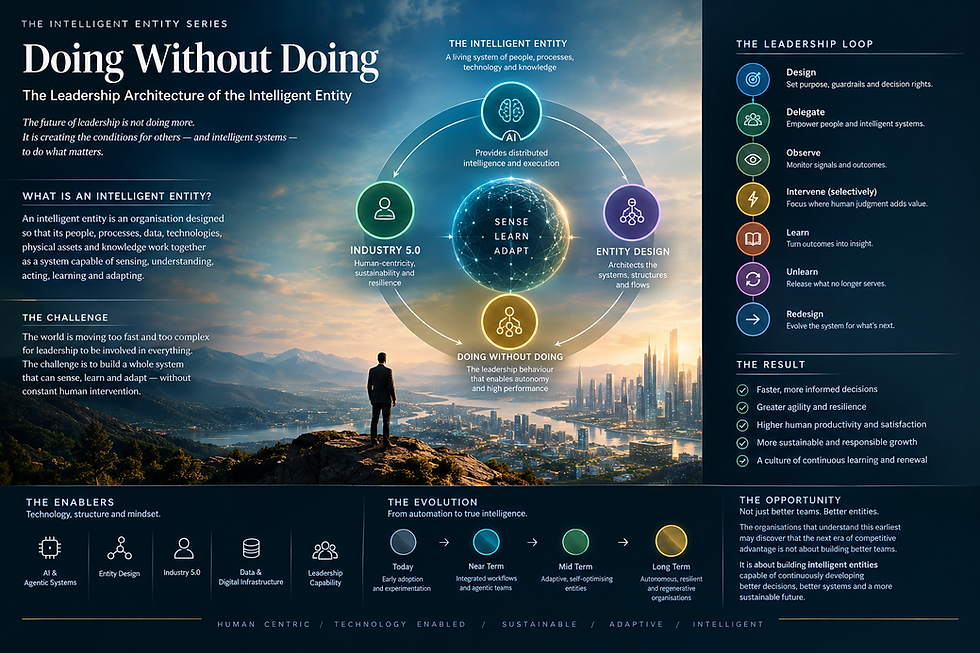
There is a paradox emerging at the centre of the AI era.
The faster organizations become, the less sustainable it becomes for leaders to remain involved in everything. For much of modern management, leadership has been associated with visible action: deciding, directing, approving, intervening, solving, escalating and controlling. The assumption is intuitive. When the environment becomes more uncertain, leaders should become more active. The intelligent organization introduces a different possibility.
Perhaps the most advanced form of leadership is not doing more. It is creating the conditions in which less direct intervention is required for more meaningful work to happen. This is the deeper significance of “Doing Without Doing.” The phrase has an ancient philosophical lineage in the Daoist concept of wu wei, commonly translated as non-action, effortless action or action without forcing. Importantly, wu wei does not mean doing nothing. The Stanford Encyclopedia of Philosophy notes that it is better understood as a mode of action that is non-coercive and aligned with the way things are unfolding, rather than action driven by excessive assertion or self-serving force.
There is now a striking parallel emerging in contemporary leadership research.
In 2024, researchers from Queen’s University introduced forbearance leadership, explicitly titled “Doing Without Doing.” They define it as purposeful non-intervention: a leader recognizes that action is possible, possesses the capability and resources to intervene, but deliberately chooses not to do so. Their research distinguishes learning-oriented forbearance, which allows people to develop capability and self-reliance, from nurturing-oriented forbearance, which gives people room to grow while preserving support and psychological safety. Across four studies involving 632 followers and 136 leader–follower dyads, the researchers found that these forms of deliberate non-intervention were associated with trust, satisfaction with supervision, reduced role ambiguity and, where leader intent and follower perception aligned, higher task performance and job dedication.
These ideas should not be treated as synonymous. Wu wei is a philosophical tradition; forbearance leadership is an emerging organizational-behaviour construct. Yet they illuminate the same strategic problem from different directions.
How do you create outcomes without becoming the bottleneck that produces them?
That question becomes extraordinarily important as organizations move into the era of intelligent entities.
The Intelligent Entity changes the role of leadership
An Intelligent Entity is an organization designed so that its people, processes, data, technologies, physical assets and institutional knowledge form a system capable of continuously sensing, understanding, acting, learning and adapting.
Such an organization cannot depend on senior leaders making every important decision. It cannot depend on managers approving every workflow. It cannot depend on employees escalating every exception. And it cannot depend on humans remaining manually embedded in every step simply because the organization has historically defined control that way. The operating environment is becoming too fast and too complex.
Artificial intelligence is accelerating this change. Organizations are moving from AI that answers questions toward AI that can execute multistep tasks, interact with systems, coordinate workflows and operate with increasing autonomy. McKinsey describes the emerging model as an agentic organization, in which humans and AI agents work together across redesigned workflows, with humans increasingly positioned above the operational loop to provide context, judgment and oversight rather than perform every step themselves.
Microsoft describes a similar progression from human-led execution, to editing AI output, to directing AI to complete tasks, and ultimately to orchestrating systems of agents operating across workflows. Its 2026 research argues that human involvement does not disappear; rather, humans increasingly define direction, standards and outcomes while less tactical execution is performed directly by people. This is where “doing without doing” becomes more than a leadership philosophy. It becomes an operating requirement.
Doing without doing is not inactivity
The greatest danger is to misunderstand the phrase. Doing without doing does not mean disengagement. It does not mean abandoning people, ignoring problems or refusing to make decisions. The contemporary research on forbearance leadership is particularly useful here because it makes intention central: the leader is aware, capable and deliberate. Non-intervention is a choice made for a reason, not an absence of leadership.
That distinction is essential. A weak leader fails to act because they cannot. A passive leader fails to act because they do not care. A leader practicing deliberate non-intervention does not act because the system is better served by allowing the appropriate person, process or intelligent subsystem to act.
The leader has already done something more consequential upstream. They have designed the conditions. They have established the purpose. They have clarified the decision rights. They have created the guardrails. They have provided the information. They have built capability. They have defined what must escalate and what should not. They have created the environment in which action can occur without waiting for them. That is why the concept belongs naturally within Entity Design.
Doing without doing is what leadership looks like when the entity has been designed well enough to act.
From intervention to architecture
Traditional organizations often use management effort as a substitute for organizational design. When the process fails, a manager intervenes. When a team cannot decide, the manager decides. When information is missing, the manager requests another report. When execution slows, another meeting is created. When accountability becomes unclear, another approval layer appears. The organization gradually accumulates intervention. What looks like control becomes friction. The result is an institution in which too much intelligence sits at the top and too little agency exists within the system. Entity Design reverses this logic.
Instead of asking how leaders can intervene more effectively, it asks how the organization can be architected so that the right intelligence reaches the right actor at the right moment with the right authority to act.
This connects closely with David Teece’s theory of dynamic capabilities. His work describes enduring competitive capability in terms of an organization’s ability to sense, seize and reconfigure in changing environments. These capabilities depend not only on technology, but on organizational processes, structures, decision rules, skills and disciplines.
The Intelligent Entity extends this logic into an environment in which machine intelligence can increasingly participate in those loops. The leader’s role therefore begins to shift from controller of activity to architect of conditions. That is a profound change.
The new leadership loop
In an intelligent entity, effective leadership begins much earlier than the moment of intervention.
The leader designs the system so that it can:
Sense what is changing, understand what matters, delegate what can be delegated, observe what happens, intervene only where intervention creates disproportionate value, and then feed the result back into the system as learning.
That creates a new cycle:
Design → Delegate → Observe → Intervene selectively → Learn → Unlearn → Redesign.
The inclusion of unlearning is critical.
Organizations have historically celebrated learning as the accumulation of knowledge. But an organization can become trapped by its own knowledge. Successful routines become assumptions. Assumptions become policies. Policies become culture. Culture becomes identity. Eventually, yesterday’s advantage becomes tomorrow’s constraint.
Research increasingly recognizes organizational unlearning as an important component of adaptation. A 2024 review describes unlearning as a dynamic process through which organizations intentionally discard or alter knowledge, beliefs and routines, while recent empirical work links organizational unlearning with digital business-model innovation through stronger dynamic capabilities.
This matters even more in the AI era. AI adoption itself forces organizations to confront inherited assumptions about how work should be performed. Research presented at the Academy of Management in 2025 identified goal-focused unlearning, stakeholder collaboration, leadership support, AI-democratization environments, guardrails and flexible organizational designs as conditions that help organizations transition from existing routines toward AI-enabled ones.
The Intelligent Entity therefore needs something more sophisticated than a learning culture. It needs a learning-and-unlearning architecture. It must know not only how to acquire a new capability, but when to stop doing something that once worked.
Why this becomes essential at machine speed
The industrial model of management was built around scarcity.
Information was scarce. Expertise was scarce. Communication was slow. Coordination was expensive. Managers therefore became information hubs. The digital era reduced some of these constraints, but the underlying organizational architecture largely survived. The emerging AI era changes the economics again. Information can increasingly be generated, processed and distributed at machine speed. Software agents can perform work continuously. Digital systems can monitor environments in real time. Simulation can test scenarios before physical execution. AI can coordinate across systems that previously required multiple human handoffs.
The bottleneck therefore moves.
The scarce resource becomes organizational capacity to absorb and act on intelligence.
Deloitte’s 2026 research provides an important signal. Enterprise AI adoption is rising rapidly, but only 34% of organizations surveyed say they are truly reimagining the business around AI. It also finds that only about one in five organizations has mature governance for agentic AI, even as expected agent use increases. The technology is accelerating faster than the organization. That gap is where “doing without doing” becomes strategically important. A leader who insists on personally controlling increasingly automated workflows creates a human bottleneck inside a machine-speed environment. A leader who removes themselves entirely creates unmanaged autonomy. The mature model sits between these extremes.
The leader designs the system, establishes its boundaries, delegates authority, watches the signal, and intervenes at the level where judgment has the greatest leverage. This is not less leadership. It is leadership operating at a higher level of abstraction.
The connection to Industry 5.0
Industry 5.0 strengthens this argument because it challenges the idea that industrial progress should be measured only through productivity and efficiency.
The European Commission defines Industry 5.0 around human-centricity, sustainability and resilience. It explicitly argues that emerging technologies should support and empower people rather than simply replace them, while helping organizations become more resilient and environmentally responsible. Doing without doing fits naturally within this philosophy. When a leader stops performing work that another person, team or intelligent system can perform effectively, that does not necessarily eliminate human value. It can create room for higher-order human capabilities: judgment, creativity, coaching, stewardship, systems thinking, ethical reasoning and relationship-building.
The objective becomes human leverage rather than human replacement.
A manager who spends six hours approving routine decisions is performing coordination. A manager who designs a system in which those decisions are safely made without them is designing organizational capability. An executive who personally resolves every exception is providing capacity. An executive who redesigns the system so that most exceptions disappear is creating resilience. A CEO who personally carries institutional knowledge is a single point of failure. A CEO who creates an organizational memory capable of preserving and distributing that knowledge has created institutional continuity. This is the deeper human-centred opportunity.
AI gives “doing without doing” a new operating mechanism
Historically, “doing without doing” depended primarily on human leadership capability. AI changes the mechanics. Consider a modern enterprise workflow. A customer need emerges. A system senses it. An AI layer interprets the context. An agent retrieves relevant information. Another agent executes a process. A human reviews only the exception. The system records the outcome. The result feeds the organizational memory. The next iteration becomes better. No executive personally intervened. Yet leadership shaped the outcome at every level.
It was present in the workflow design, the decision rights, the objective function, the data architecture, the escalation rules, the governance and the learning mechanism. This is precisely why the emergence of agentic AI should not be understood as an automation story alone.
It is an organizational architecture story. McKinsey’s recent work argues that scaling agentic AI requires the redesign of business models, operating models, governance, workforce structures, technology and data, while Microsoft similarly emphasizes that the future organization will depend on deliberately matching work to different patterns of human–AI collaboration. The Intelligent Entity provides a useful conceptual destination for that transformation.
From “human in the loop” to “human above the loop”
There is a subtle but important leadership transition underway.
In conventional AI systems, humans tend to remain in the loop. The machine performs part of the task and waits for human review before continuing. That model works for bounded workloads. It becomes difficult to sustain when intelligent agents operate across thousands or millions of decisions. Humans cannot efficiently review everything.
McKinsey therefore increasingly describes a future in which humans operate above the loop. Rather than checking every operational action, humans define context, oversee systems, manage exceptions and exercise judgment at consequential decision points. This is remarkably close to the managerial logic of doing without doing. The human does not disappear. The human moves upward. The leader moves from executor to architect, from approver to governor, from problem-solver to system designer, and from constant intervenor to high-leverage decision-maker.
That is the leadership architecture required for intelligent entities.
What leaders must do before they can stop doing
There is, however, an important paradox. You cannot achieve doing without doing by simply deciding to intervene less. The system must first earn that autonomy. That requires deliberate design. Leaders must create clarity about purpose and outcomes. They must determine which decisions can be delegated and which cannot. They must establish data and knowledge foundations. They must make institutional memory accessible. They must build trustworthy AI systems with explicit boundaries. They must redesign workflows rather than simply insert AI into existing ones. They must cultivate employees who can exercise judgment rather than wait for instructions. They must create feedback loops in which outcomes change future behaviour. And they must establish governance capable of operating at the same speed as the systems it governs. Deloitte’s 2026 research is instructive here: only 21% of surveyed enterprises report mature governance for agentic AI, while only 15% report having scaled orchestrated, cross-functional multi-agent adoption. The implication is clear. Autonomy without architecture is risk. Doing without doing becomes powerful only when the organization has been designed to support it.
The Intelligent Entity is therefore a leadership system
This brings the argument full circle. An intelligent entity is not simply one that has powerful AI. It is one in which intelligence can move through the organization without repeatedly waiting for a small number of human decision-makers. It can sense without being told to look. It can learn without waiting for an annual review. It can identify when assumptions are failing. It can unlearn outdated routines. It can act within clearly defined boundaries. It can escalate the exceptional cases. It can preserve institutional memory. It can adapt its operating model as conditions change.
And its leaders can spend more time determining where the organization should go and what kind of organization it should become, rather than personally managing every mechanism through which it gets there. That is the meaning of doing without doing at organizational scale. It is not the absence of action. It is the deliberate creation of conditions in which action no longer requires constant intervention.
The next industrial era may belong to organizations that master restraint
The industrial eras that preceded this one were largely defined by the expansion of human ability. Machines multiplied physical strength. Automation multiplied operational consistency. Digital systems multiplied information capacity. Artificial intelligence is now beginning to multiply cognitive capacity. But every increase in capability creates a new organizational question. What should humans continue to do? The answer cannot simply be “more.” More meetings. More oversight. More approvals. More dashboards. More management. More intervention. That would be an industrial-era organization trying to manage an intelligence-era system. The more advanced possibility is different. Humans define purpose. Organizations define architecture. AI provides intelligence and execution. People exercise judgment where judgment matters most. The system observes itself. The organization learns. The organization unlearns. The organization adapts. And leadership becomes increasingly visible not through how much activity it personally performs, but through how effectively the entity performs without needing to be constantly directed.
This is the paradox at the heart of the Intelligent Entity: the better the organization is designed, the less leadership needs to intervene in the ordinary course of work; yet the more important leadership becomes in designing the conditions, boundaries, values and intelligence that make such autonomy possible. That is why Doing Without Doing may become one of the defining leadership principles of the next era of industrialization. Not because the future belongs to leaders who do nothing. It belongs to leaders who know what must be designed, what must be delegated, what must be observed, what must be unlearned, and where intervention still matters.
In the age of intelligent entities, the highest form of organizational action may increasingly be the ability to create a system that can act intelligently without being continually told what to do. That is not less leadership. It is leadership evolved for a world where intelligence is no longer scarce, decision cycles are collapsing, and the speed of the organization may finally begin to approach the speed of change itself.



Comments