The Scientific Enterprise Is Becoming an Adaptive Institution (Augmented with Chatgpt 5.6 GPT Luna)

Why the next advantage in AI-native science will depend on an institution's ability to learn from its own discovery process
By Leke Abaniwonda Entity Design Expert | Industry 5.0 Innovation Consultant | Transdisciplinary Innovation Specialist
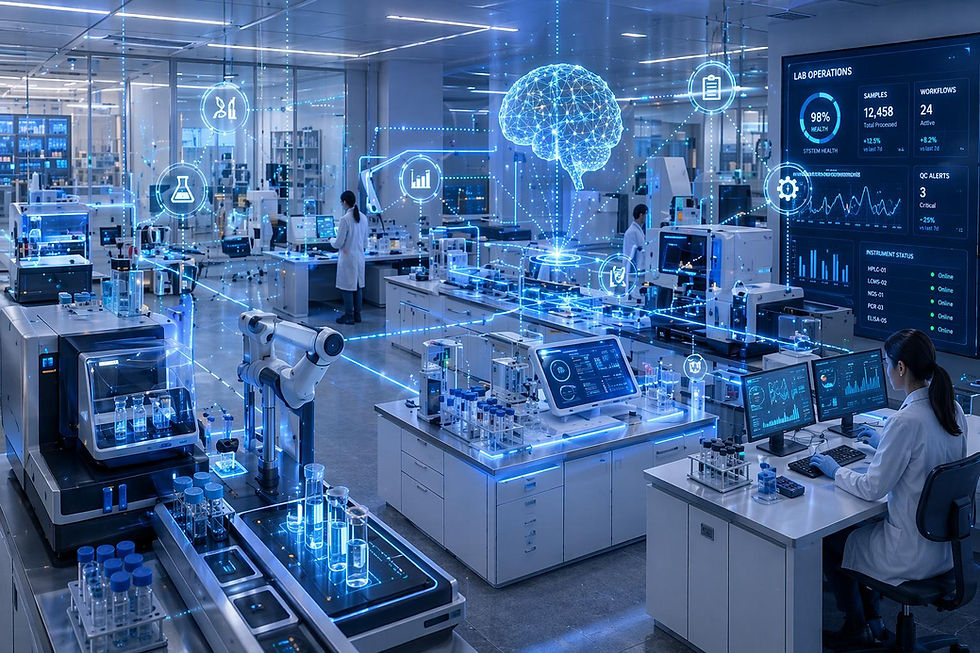
In my previous article, I examined how the scientific enterprise is beginning to resemble an intelligent system. The argument was that artificial intelligence is moving beyond its traditional role as a tool for individual researchers and beginning to participate in several connected stages of the scientific process, including literature analysis, hypothesis generation, experimental design, data interpretation and subsequent iteration. The significance of this development is not simply that individual scientific tasks can be performed more quickly. It is that the relationships between those tasks can increasingly be designed as a connected system.
That observation leads to the next question in the development of AI-native science. Once intelligence becomes embedded within the scientific discovery process, how does the organisation itself change? An intelligent workflow does not automatically create an intelligent institution. A research organisation can deploy increasingly capable AI systems, automate laboratory processes and produce substantially more experimental data while continuing to operate with fragmented knowledge, disconnected teams and decision processes that do not systematically incorporate what the organisation has learned. The institution can therefore become more automated without becoming correspondingly more adaptive.

The distinction between automation and institutional learning is becoming increasingly important because the scientific process is itself becoming more connected. In May 2026, Nature published research describing Google's Co-Scientist, a multi-agent AI system designed to generate, critique, rank and refine scientific hypotheses in response to research objectives and existing scientific evidence. The same issue included research on Robin, a multi-agent system developed by FutureHouse that integrates literature search, hypothesis generation, experimental planning, laboratory data analysis and follow-up hypothesis generation into a continuous workflow. Robin was used to investigate therapeutic strategies for dry age-related macular degeneration, with human researchers conducting laboratory experiments and returning the resulting evidence to the system for further analysis.
These developments matter because they change the structure of the scientific feedback loop. When a system can generate a hypothesis, identify an experimental approach, receive new evidence and use that evidence to revise its next hypothesis, the process is no longer limited to automating isolated activities. It begins to resemble a learning process in which the result of one stage influences the conditions under which the next stage is performed. The role of the surrounding organisation therefore becomes more significant because the organisation determines what information is available, which experiments can be performed, which outcomes are considered reliable and how newly generated knowledge is retained.
This becomes especially consequential as experimental capacity increases. A scientific organisation can generate enormous quantities of information without necessarily increasing its ability to learn from that information. The distinction matters because scientific knowledge is not equivalent to data stored in a repository. The organisation also needs to preserve the assumptions that informed an investigation, the alternatives that were considered, the reason a particular experiment was selected, the limitations of the result and the implications that the researchers believed followed from it. A failed experiment can therefore have considerable strategic and scientific value when its underlying reasoning and implications remain available to inform future work.
Institutional memory should consequently be treated as a component of scientific infrastructure rather than simply as a documentation function. A mature research organisation needs mechanisms through which evidence remains connected to the decisions that generated it and to the decisions that it should influence later. When that connection is preserved, the institution becomes progressively better at recognising patterns, avoiding unnecessary repetition, identifying promising directions and allocating scarce experimental resources.
The economic implications are particularly visible in fields such as drug discovery, where computational search spaces are exceptionally large while physical validation remains comparatively expensive. AI can expand the number of hypotheses that researchers are able to consider, but the resulting value depends on how effectively computational reasoning can be connected to physical experimentation and scientific interpretation. Robin's work is significant in this respect because it does not end at hypothesis generation. Its workflow uses literature analysis to generate candidate mechanisms, proposes experimental strategies, analyses experimental results and then uses those results to inform further hypotheses.
The U.S. Department of Energy's approach to AI-driven autonomous laboratories demonstrates that this architectural question is also emerging at the level of national scientific infrastructure. The Department's Genesis Mission describes an integrated approach that combines AI systems, robotics, edge computing, real-time analysis, intelligent feedback, hypothesis generation and scientific data curation within experimental workflows. The broader Genesis platform is explicitly designed to connect supercomputing, experimental facilities, AI systems and scientific datasets rather than treating each capability as an isolated asset.
This is a meaningful shift in how scientific infrastructure is conceptualised. The laboratory is no longer simply the place where an experiment occurs. Computational systems, data environments, scientific instruments, robotic systems and human researchers increasingly form one connected environment in which information can move between digital and physical processes. The scientific institution consequently needs an operating architecture that can maintain those connections reliably and govern how they are used.
Such an architecture would include a persistent information environment containing both relevant external scientific knowledge and the organisation's internal experimental evidence. It would include AI systems capable of reasoning over that environment, generating candidate explanations and identifying areas where further investigation is justified. It would include experimental systems capable of translating selected hypotheses into physical tests and instrumentation capable of producing reliable data. It would also include evaluation mechanisms that distinguish sufficiently supported findings from uncertain or contradictory ones, together with governance structures that determine where autonomous activity is permitted and where human authorisation remains necessary.
The quality of that architecture will increasingly determine how much practical value an organisation receives from its AI systems. A sophisticated model that cannot access trustworthy information, understand the provenance of experimental data or interact meaningfully with the research environment remains constrained by the architecture around it. Conversely, an organisation with strong information, experimentation and governance infrastructure may be able to derive substantial value even as the underlying models continue to change.
This is also where the role of the scientist changes rather than simply disappears. Industry 5.0 provides a useful framework for understanding this transition because it places human-centricity, resilience and sustainability alongside technological advancement. The European Commission's Industry 5.0 framework explicitly positions technology as a means of increasing industrial capability while maintaining human wellbeing and broader societal value.
In an increasingly intelligent scientific environment, the most important human contribution may therefore shift toward the parts of the discovery process that depend heavily on context, interpretation, accountability and scientific judgement. An AI system can examine large scientific corpora much faster than a human researcher can manually review them, and an automated laboratory can perform repetitive experiments at a scale that would be difficult for a human team to sustain. The human contribution remains essential in deciding which problems warrant attention, determining whether evidence is meaningful within the relevant scientific context, challenging assumptions and recognising when an apparently promising result does not justify further investment.
That allocation of human and machine capabilities is important because scientific validity and scientific significance are not identical. A computationally plausible hypothesis may still be irrelevant to the real problem being investigated. An experimental result may be statistically interesting but biologically unimportant. A technically successful process may create unacceptable clinical, ethical or environmental consequences. Greater machine capability therefore increases the need for organisations to establish where human expertise should intervene rather than reducing the importance of human judgement.
The same principle applies to governance. As scientific systems become capable of performing longer sequences of autonomous actions, governance can no longer exist solely as a policy document reviewed after implementation. The organisation needs explicit decision boundaries within the system itself. It must determine which activities the AI can initiate, which require human approval, what level of evidence is required before a hypothesis receives access to scarce physical resources, how experimental provenance is recorded, how anomalous findings are escalated and who retains accountability for consequential decisions.
These requirements point toward a broader organisational transition. The scientific enterprise is moving from a collection of functions toward an integrated learning architecture in which intelligence, evidence, experimentation, people and governance interact continuously. The institution does not become intelligent merely because it has access to an intelligent model. It becomes increasingly adaptive when the knowledge produced through its own activities can alter how subsequent activities are selected and executed.
This distinction is central to how I have been thinking about Entity Design. I use the term to describe the intentional architecture connecting purpose, people, intelligence, information, infrastructure, decisions, governance and feedback into a coherent entity. The objective is not simply to insert advanced technology into an existing organisation. It is to design the organisation so that the different forms of capability it possesses can interact in a way that allows the entity to sense its environment, develop understanding, act on that understanding, learn from the consequences and adjust how it operates.
AI-native science is becoming one of the clearest examples of this transformation because scientific discovery already contains the fundamental ingredients of a learning system. Researchers observe phenomena, construct explanations, conduct experiments, interpret results and revise their understanding. The new development is that increasingly capable AI systems and autonomous laboratory infrastructure can participate across more of those stages, increasing both the scale of activity and the speed at which evidence can influence subsequent inquiry.
The strategic advantage will therefore not necessarily belong to the organisation with access to the most capable individual model. It is increasingly likely to belong to organisations that can integrate intelligence into a durable system of evidence, experimentation, judgement and learning. Such organisations will be better positioned to preserve what they discover, recognise what changes, allocate resources against emerging evidence and adapt their research priorities as their understanding of the problem evolves.
The scientific enterprise is consequently entering a phase in which institutional design becomes as important as model capability. The question for research leaders is not simply how much AI they can introduce into existing workflows. It is whether the organisation's underlying architecture is capable of converting machine-generated possibilities and experimental evidence into cumulative institutional knowledge.
That is the transition from an intelligent scientific system to an adaptive scientific institution. It involves a change in how knowledge is retained, how experimentation is organised, how human expertise is deployed, how governance is embedded and how the organisation determines what it should learn from each cycle of discovery. The institutions that make this transition successfully will not simply conduct more research. They will become more capable of directing their own future research because their accumulated experience increasingly informs the decisions that follow.


Comments