The Scientific Enterprise Is Becoming an Intelligent System (Augmented with GPT 5.6 Luna)

Updated: Oct 4

What a small gathering in San Francisco reveals about the next architecture of scientific discovery
By Leke Abaniwonda
Entity Design Expert | Industry 5.0 Innovation Consultant | Transdisciplinary Innovation Specialist
On September 29 and 30, 2026, Foresight Institute convened approximately sixty researchers, scientists, engineers and funders in San Francisco for a workshop that, on the surface, belonged to the rapidly expanding field of AI for science. Its underlying proposition was more consequential. The AI for Frontier & Meta Science Workshop brought together work in NeuroAI, brain-computer interfaces and whole-brain emulation; longevity biotechnology and molecular nanoscience; and the scientific and epistemic infrastructure needed to make AI-first discovery practical, scalable and responsible. The format was intentionally designed for collaboration rather than passive attendance: brief presentations were followed by working groups, mentorship, open breakouts and project incubation, with ideas developed at the workshop potentially eligible for further funding. Discussions were conducted under Chatham House Rule, which means the public record should not be used to reconstruct private conversations or attach unpublished ideas to individual participants. It does, however, provide a clear view of the problems Foresight believes are most worth convening around.
That choice becomes easier to understand in the context of Foresight itself. The Institute has operated since 1986, when it was founded by Christine Peterson and Eric Drexler, and its current programme spans frontier work in artificial intelligence, longevity biotechnology, molecular nanotechnology and neurotechnology. Allison Duettmann, Foresight's CEO, leads that portfolio of grants, fellowships and prizes and co-created its AI Science & Safety Grant Program. The organisation has also been building physical AI Nodes in San Francisco and Berlin that combine project funding, local compute, office space and community support for teams using AI to advance science and safety. In San Francisco, Rachel Farley manages the AI Node after a background that included semiconductor operations at TSMC, while Lydia La Roux manages seminars and workshops and supports the broader programme and community infrastructure.
The institutional design is revealing because it mirrors the scientific problem. Foresight is not only trying to identify researchers who can make progress at the frontier; it is trying to build an environment in which those researchers can obtain the compute, capital, collaborators, infrastructure and concentrated time required to turn an idea into a working system. Its AI Node programme describes this explicitly: the objective is to provide funding, compute and community for AI-first projects in science and security, with researchers able to remain in the Bay Area office for periods of concentrated building around the workshop.
That becomes increasingly relevant because artificial intelligence is beginning to enter the scientific process itself rather than merely accelerating individual tasks.
The discovery loop is changing
Scientific discovery has always depended on an iterative relationship between observation, hypothesis, experimentation and analysis. What has changed is the ability to place machine intelligence inside that loop.
In May 2026, Nature published independent work on Google's Co-Scientist and the FutureHouse-led Robin system. Co-Scientist uses multiple specialised AI agents to generate, critique, rank and refine scientific hypotheses from a research objective and the existing scientific record. Robin is designed to automate hypothesis generation and experimental-data analysis, allowing it to generate hypotheses, propose experiments, interpret results and formulate revised hypotheses in response to new evidence. Both systems are explicitly designed around expert involvement rather than the removal of scientists from the process.
The distinction matters because it changes where the bottleneck sits. When literature review, hypothesis generation and parts of experimental planning can be performed at machine speed, the limiting factor becomes the quality of the surrounding system: whether relevant information is accessible, whether experiments can be executed, whether results can be interpreted reliably, and whether the organisation can decide which machine-generated possibilities warrant scarce physical resources.
This is already visible in biomedical research. Co-Scientist was used across drug repurposing, novel-target discovery and antimicrobial-resistance research, and its investigators reported in-vitro validation of several AI-generated hypotheses. In one example, the system identified epigenetic modifiers and candidate drugs for liver fibrosis, with two of the drugs showing anti-fibrotic activity in hepatic organoids without cellular toxicity; one of the candidates, vorinostat, is already approved for a different cancer indication, creating a plausible repurposing pathway. In another demonstration, the system generated a hypothesis explaining how broad-host-range mobile genetic elements spread antibiotic-resistance genes across bacterial species, and its highest-ranked mechanism matched the subsequently validated experimental explanation.
The important point is not that an AI system has replaced the scientist. It has not. The published evidence instead shows a narrower and more interesting development: software is beginning to perform several consecutive stages of the scientific method and to connect those stages into a feedback loop. Once that loop becomes operational, the question of organisational design changes with it.
Drug discovery makes the economic logic particularly clear
Drug discovery is one of the clearest domains in which this architectural change can create value because the search space is extraordinarily large while physical validation remains expensive and slow.
A therapeutic programme must move through target identification, mechanism discovery, molecular design, synthesis, biological validation, pharmacology, toxicology and clinical testing. AI can potentially reduce the amount of human effort required to search the computational space, but the value of that acceleration depends on how effectively computational predictions can be connected to physical experiments and eventually clinical evidence.
The development of rentosertib, formerly ISM001-055, provides a useful case. Researchers using a generative-AI platform identified TNIK as a therapeutic target for idiopathic pulmonary fibrosis and generated a corresponding small molecule. The reported discovery process from target identification to candidate nomination took approximately eighteen months, after which the compound entered a randomised Phase 2a trial. The study subsequently reported a favourable safety profile and a preliminary signal in lung function at the highest tested dose. Because the trial was relatively small and was not designed to establish definitive clinical efficacy, the result should be understood as evidence of accelerated AI-supported discovery rather than proof that AI has solved pharmaceutical development.
That distinction points to where the durable economic opportunity lies. Compressing one computational step is useful; compressing the feedback cycle between computational reasoning, physical experimentation and scientific interpretation is potentially transformational. An AI system that can search millions of candidate relationships but cannot reliably determine which experiments should be run has limited practical value. A laboratory capable of executing thousands of experiments but unable to capture and reuse the resulting knowledge has a different form of inefficiency. The greater opportunity emerges when both become parts of a single learning system.
The architecture around the model becomes a strategic asset
This is the significance of the third pillar of Foresight's workshop: AI for better scientific and epistemic infrastructure. The workshop description explicitly identifies the need for platforms, tools and data infrastructures that can accelerate AI-guided scientific progress while accounting for the risks created by increasingly capable systems. That requirement is easy to underestimate because infrastructure is usually less visible than the model itself. Yet the model is only one component in a discovery system that also requires trusted data, provenance, compute, instrumentation, laboratory automation, simulation, access controls, evaluation protocols, human oversight and mechanisms for feeding experimental results back into the next cycle of inquiry.
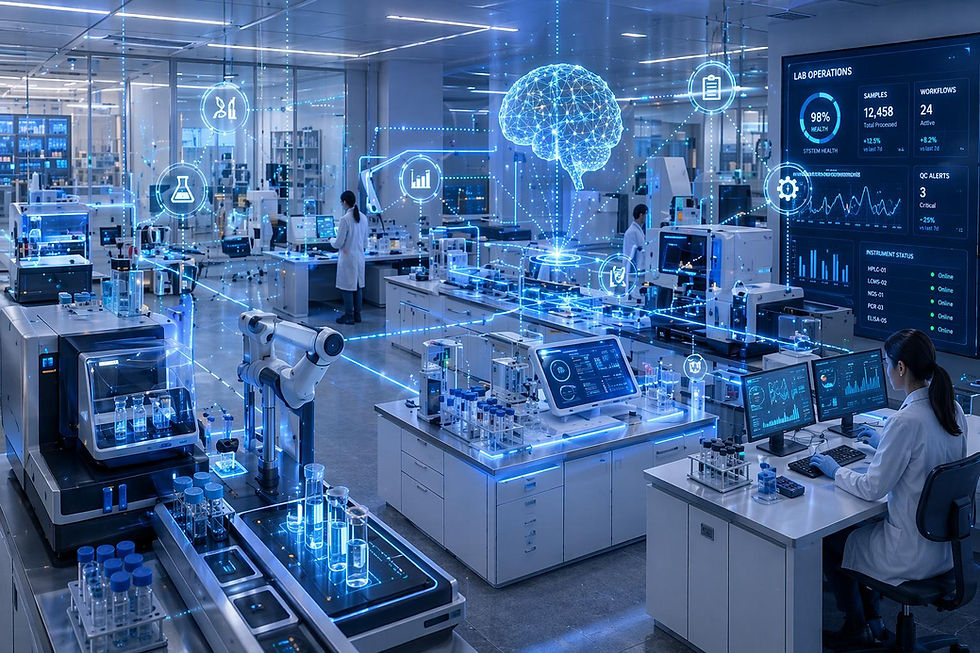
This is where the future of R&D begins to resemble the future of complex enterprise operations. A pharmaceutical organisation could eventually maintain a continuously updated scientific knowledge environment in which literature and internal experimental evidence are represented alongside computational models. AI systems could explore hypotheses and molecular designs against that environment, select experiments according to predefined constraints, and interact with automated laboratory systems capable of generating new data. Scientists would remain responsible for framing objectives, challenging assumptions, investigating anomalies and determining when the available evidence justifies escalation toward more expensive stages of development. Governance would define where autonomous activity is permissible and where human approval is mandatory.
Such an organisation would still contain laboratories, scientists, technology teams and executives, but those components would no longer operate primarily as adjacent functions.
They would form a connected discovery system. That is why I have increasingly used Entity Design to describe the kind of work required for this transition. I think of an entity as the architecture connecting purpose, people, intelligence, information, infrastructure, decisions and feedback. The design objective is to enable the entity to sense what is occurring, develop sufficient understanding to act, learn from the results and adapt how it operates as conditions change. AI-native science is becoming an unusually clear demonstration of that principle.
Industry 5.0 gives the architecture a human purpose
The other reason this matters is that increasingly autonomous science should not be framed solely as an automation problem. Industry 5.0 provides a more useful operating philosophy because it places human value, resilience and the relationship between people and intelligent machines alongside productivity. A laboratory in which software and robotics perform more of the search and execution can become more productive without becoming less human, provided the system is designed so that human expertise moves toward the activities for which contextual judgement, accountability and interpretation are most valuable.
A machine can search a scientific literature corpus faster than a scientist can read it. A robotic laboratory can run experiments continuously. A computational system can explore a molecular space that would be prohibitively expensive for a human team to investigate exhaustively. The scientist's role, however, can become more consequential rather than less, because the organisation now has to determine which questions are worth asking, what evidence is sufficiently reliable, which contradictions matter and where a technically valid result may still be biologically or clinically irrelevant.
The goal is therefore not a laboratory without scientists. It is a laboratory in which human and machine capabilities are deliberately allocated across the same discovery loop.
The implication extends beyond life sciences
The same architecture is beginning to emerge in industries where AI interacts with physical or scientific systems. Advanced manufacturers are combining generative design, simulation, sensors and robotics with production operations. Energy organisations can connect AI with geological models, infrastructure and operational data. Aerospace companies can combine engineering simulation with autonomous systems and manufacturing. Healthcare organisations can connect large-scale data, clinical workflows and decision support. In each case, the strategic question is moving beyond whether AI can improve an individual task and toward whether the organisation can integrate intelligence into a continuous cycle of observation, decision, action and learning.
Recent research from Deloitte's Canadian enterprise work is reaching a parallel conclusion from the opposite direction: organisations report significant AI-related productivity gains, but data quality and legacy-system integration remain material constraints, and many companies continue to focus on efficiency rather than redesigning how work gets done.
That is the broader lesson contained in the Foresight workshop. The frontier is not simply producing more intelligent models. It is producing entities and institutions capable of turning those models into reliable learning systems. The scientific enterprise is therefore approaching a structural transition. The unit of competitive advantage may increasingly be neither the model nor the laboratory on its own, but the architecture that connects intelligence to evidence, experimentation, human judgement and institutional learning.
As that architecture becomes more mature, the most capable research organisations may not simply conduct science faster than their predecessors. They may be organised differently because of what intelligence has become capable of doing.


Comments